Smoked Mackerel on Rye Toast

Smoked Mackerel Rye Toast

I’ll admit, I haven’t been cooking much lately – it’s restaurant week in Newcastle and we’ve been trying some of the City’s specially prepared set menus. It’s been great, but the waistline will only take so much.

So, I thought I’d post this dish I made last weekend. We actually had it for breakfast but it would make a great light lunch.

Mackerel has made the headlines in the UK recently, being reduced from a fish ‘suitable to eat’ by the Marine Conservation Society to one we should eat only occasionally. Shame as it’s a favourite of mine and very good for you. The jury is still out apparently though so let’s see what happens.

This is very simple but very tasty, if a bit decadent, using butter and a little single cream. The mackerel is grilled under a high heat and combined with scrambled egg, parsley and  wholegrain mustard. It’s served up on some buttered hot rye bread toast. Heaven.

I used a take on the Heston Blumenthal ‘bain-marie’ method for cooking the eggs as it leaves them lovely and soft, but the regular pan method works too!

Serves 2

  • Two smoked mackerel fillets
  • 1 tbsp chopped parsley
  • 4 free-range eggs
  • 1 tsp wholegrain mustard
  • About 2 tbsp single cream
  • 1 knob butter
  • 2 sliced of rye bread, toasted and buttered.
  • Salt and Pepper
  • Tartare sauce to serve.

Remove the skin and grill the mackerel fillets under a high heat, skinned side down, until nicely coloured. About 5 minutes if the grill is preheated.

Turn the grill off and leave at the bottom until ready to use.

Next – make the scrambled egg. in a small pan, bring some water to a boil (or use some from a kettle). Add a heat proof bowl on top so it sits on top of the pan and melt in the butter. Whisk in four eggs thoroughly until an even colour. With the water boiling below, stir often; it takes a while but the eggs will eventually begin to scramble. The gentle heat allows you to get the consistency just right, and catch it before it starts to turn ‘rubbery’.

Whilst this is happening, get the toast under the grill.

Once ready (a cooked risotto-like consistency), remove the bowl from the heat.

Slice the mackerel fillets and add to the eggs along with the cream and mustard. Stir thoroughly. Season with the pepper and salt only if it’s needed (the mackerel should be salty enough). Finish with the parsley and serve up on the toast, with some tartare sauce if you like!

Smoked Mackerel and Egg on Rye Toast

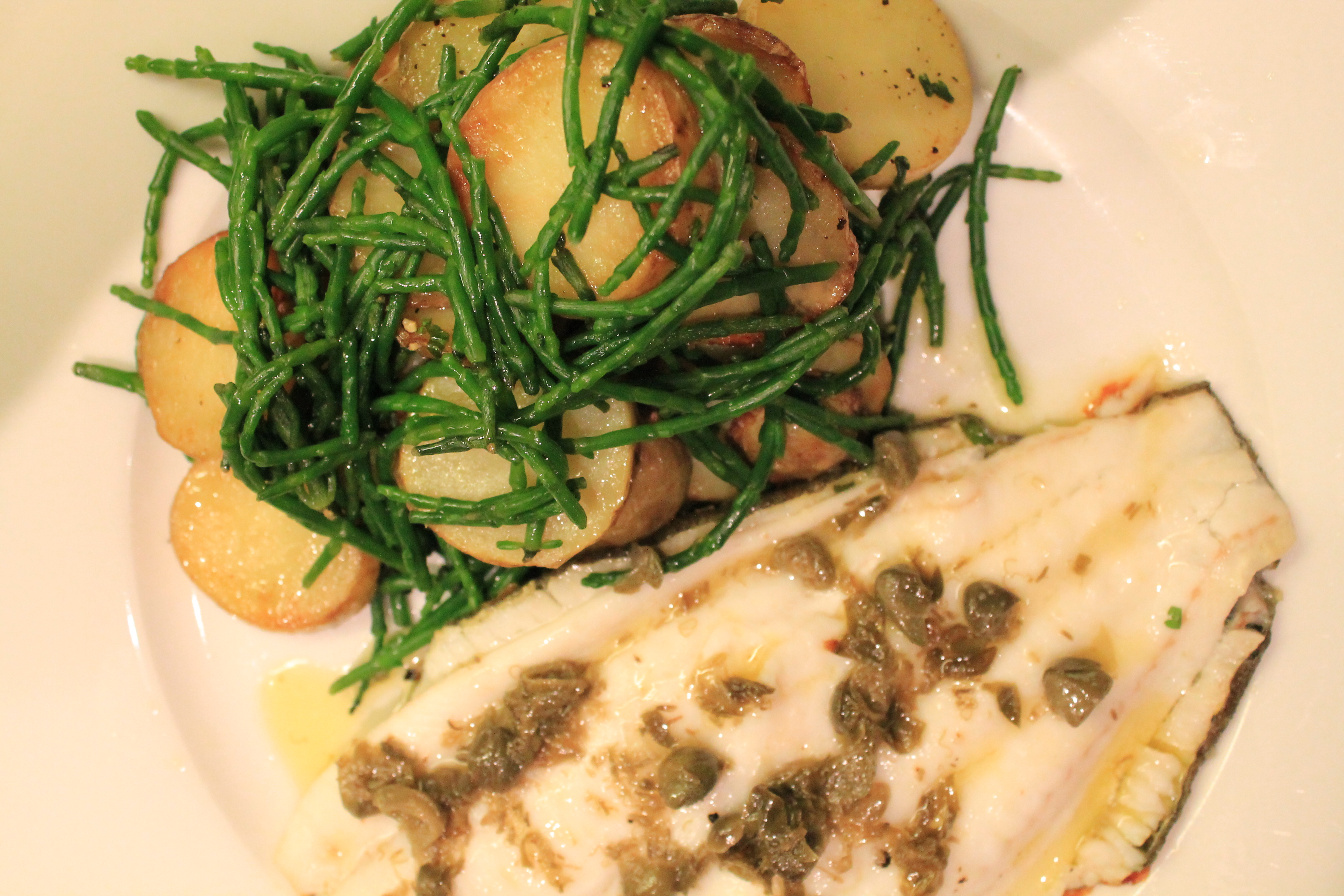
Plaice with Sautéed Potatoes and Samphire

Plaice Sauteed Potatoes Samphire

I tend to do so many things accidentally as I’m so badly organised. It’s been snowing across the UK of late and with my wife’s car not being the most ‘snow friendly’ vehicle found myself driving her to work.

On the way, I passed our local fish deli which was open this time and I dropped in on the way back to the office. The store is called Latimer’s and they seem seriously dedicated to fresh fish, providing produce to a number of restaurants in the North East. Their website even has a page entitled ‘Today’s Catch’. I can vouch that the service is excellent and it’s a goldmine of advice.

I asked for a couple of plaice fillets (although in truth could have tried a bit of everything) and the guy serving asked if i minded hanging on while he cut the fillets as the fish had “only just come in”. Of course I didn’t – no vacuum packed week old fish sold here…

Plaice is a delicate fish and can be ruined by heavy or strongly flavoured sauces so I tried to keep it light, with a simple tried and tested caper butter. Samphire is now easily available, works brilliantly with fish and keeps a nice ‘bite’ even after cooking.

Helen made the sautéed potatoes and we went for some small new potatoes for a slight sweetness. She didn’t peel the potatoes and I think they’re all the better for it!

This is just my sort of thing and I thoroughly enjoyed it….

Ingredients:

  • 2 Plaice fillets, about 200g each
  • 1 tsp oil
  • A small knob of butter
  • About two tbsp capers, drained and chopped roughly
  • Sea salt
  • About 10 small new potatoes, thinly sliced
  • Oil for frying
  • Salt and Pepper
  • Some fine chopped parsley
  • (Optional) garlic infused oil to finish
  • Two large handfuls of samphire

Start the sauteed potatoes first by frying with a good pinch of salt on a moderate heat in a large pan for about 15-20 minutes. Some recipes call for par boiling them first, but it wasn’t necessary here.

The fish and the samphire cooking quickly, so start these only at the end of cooking the potatoes. The oven grill will be used so get that on if it takes a while to heat up (like mine). Heat the plates.

Bring a pan of water to the boil (or use a kettle) and blanch the samphire for a couple of minutes. Drain and return to the pan with a lid on to keep warm.

Heat a pan large enough for the fish with a small amount of oil until hot. Lay the fish onto the pan and hold them down to begin with to try and prevent them curling up too much.

They will take only minutes to cook from the bottom, but finish briefly in the same pan under a medium grill.

Once the potatoes are done, finish with a little garlic infused oil (if you want) and chopped parsley. Plate up the fish, potatoes and samphire.

To make the caper butter, simply return the fish pan to the hob and heat the butter and capers with a pinch of salt (and a squeeze of lemon if you want). Spoon it over the fish and you’re done.

Plaice Samphire Sauteed Potatoes Top View

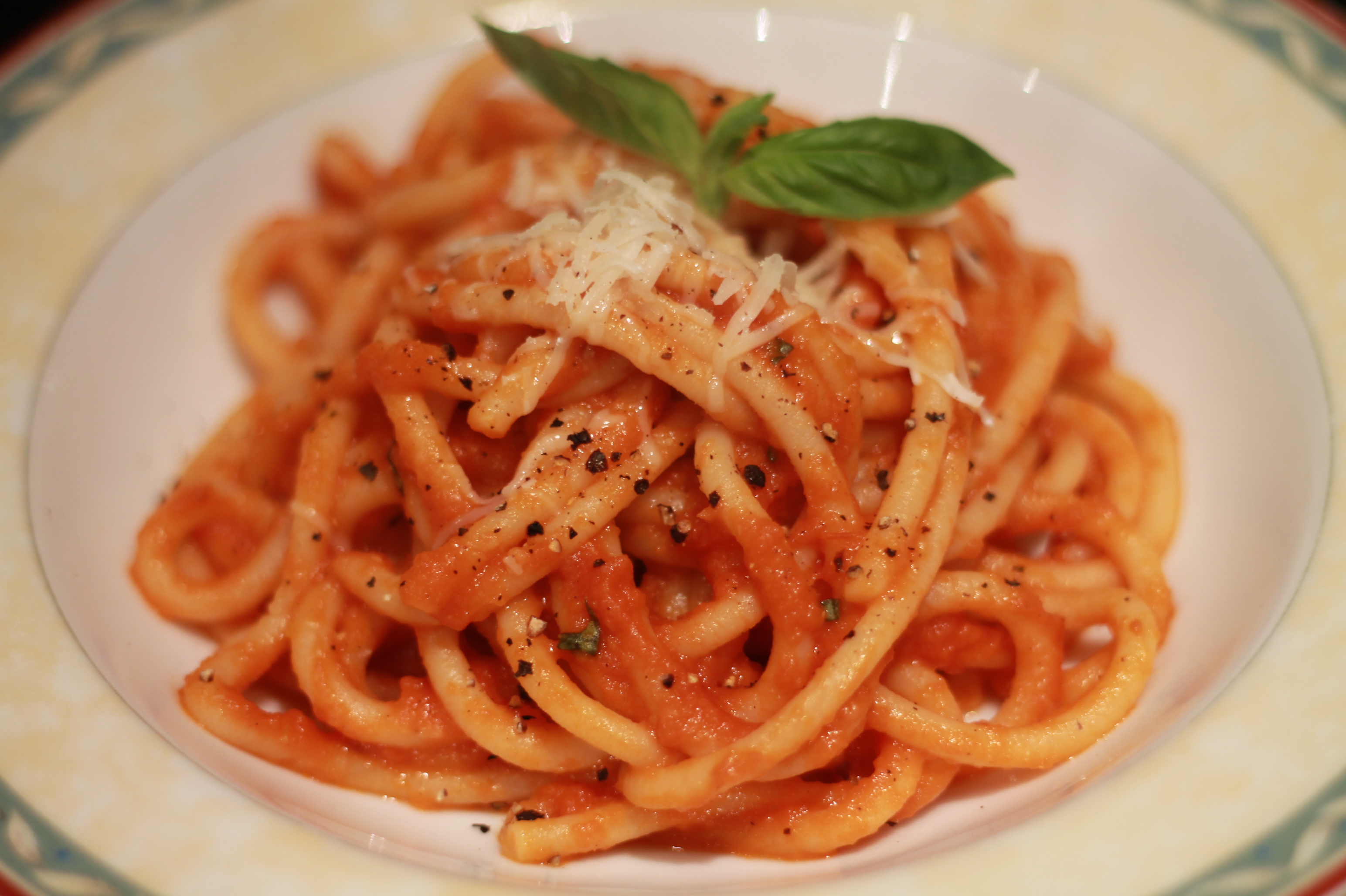
Pici Pasta and Tomato Sauce

A few years ago now a group us went  on a trip to Tuscany, staying in a hillside villa. It’s a fantastic place, full of history, beautiful villages and enormous elaborate churches. Lots and lots of churches in fact.

As has been typical for many of our holidays, the weather was terrible on arrival. We’d packed summer gear but on arrival the locals explained (graciously, in English) that it was the worst weather they’d experienced for about 15 years. But, thankfully,  the weather did perk up though and we got to visit Pisa, Florence, Sienna and Montepulciano, a fabulous little town with great wine shops doing a roaring trade in exports. It was on the way to Montepulciano we stopped at a cafe in a small roadside village. Full of locals, it was just the sort of stereotypical place I expected to see in Italy. A mis-match of furniture with chequered paper table covers and constant exuberant chatter of the locals. Just my kind of place!

Being a huge fan of Italian food, I could have tried the entire menu, but I ordered Pici pasta, a Tuscan ‘specilialty’ the roughly translated menu read. It’s basically spaghetti with gigantism, being (typically) hand-rolled lengths of pasta. This gives in an uneven thickness as a result. It came with an excellent meat ragu sauce and was delicious, in fact I was tempted to go for seconds.

I was pleased therefore to find some recently in a local deli. It was machine made and had none of the endearing ‘wonkiness’ going on but was close enough for me!

I tried to keep it basic and made it with a simple tomato sauce and basil. It wasn’t quite as good as that spur of the moment stop in Italy of course, but it was close enough until I can return.

Serves 2.

  • 200g Pici pasta
  • 1 can of tomatoes
  • 1 large garlic clove, sliced
  • 1 stick of celery and 1 medium carrot,  finely chopped
  • 1 large onion, sliced
  • Olive oil for frying
  • a handful of basil leaves, chopped roughly.
  • About a tsp of sugar (if you need it)
  • salt and pepper to taste

The sauce benefits from being cooked on a low simmer for a while. Start with this because the sauce will wait for the pasta, but the pasta will not wait for the sauce once it’s drained!

Start by frying the vegetables (except the tomatoes) in some olive oil for a few minutes on a gentle heat until the onion is soft and slight browned.

Add the tomatoes and allow to simmer away for a good 20-30 minutes. Halfway through (before it gets too thick) I used a stick blender to make it smooth, but you don’t have to.

Halfway through the sauce cooking time, cook the pasta in a large pot of boiling salted water. It’s thick and so takes a good 20-22 minutes to cook.

Just before the pasta is ready, finish the sauce. Add the sugar if needed (I did – we don’t get the beautifully sweet tomatoes the Italians are spoiled with) and salt to taste. Stir through the chopped basil and a little more oil if you like. Take it off the heat.

Drain the pasta and return to the pan. Use spaghetti tongs and mix the sauce in thoroughly. Prego!

Pici Pasta

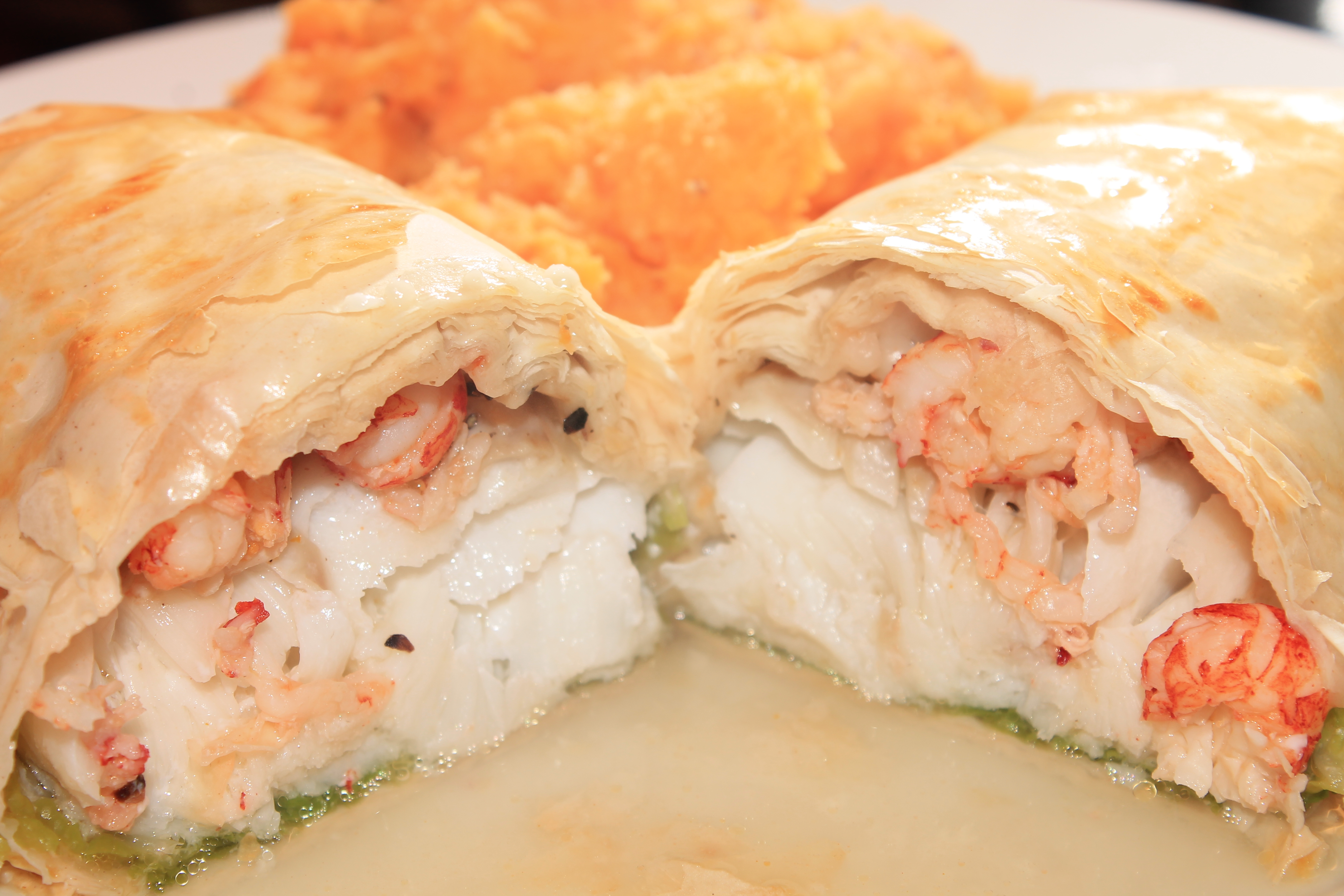
Cod and Crayfish Filo Parcels


Cod and crayfish - preparing

The first snow of this winter started falling today and I must say it makes a welcome change from the rain. This is the UK though and ‘attractive’ weather will never do, turning quickly to ugly grey slush followed by sleet. Sleet; basically even colder rain. Wonderful.

My first thoughts for dinner then would be of something hearty – a beef stew or sausage casserole maybe? Well no, as pescatarian January rumbles on it’s still off limits. Now, I love fish, and until now have been managing perfectly nicely. I probably order fish in restaurants as often as meat (perhaps more so actually) so this is no chore for me, but I did fancy something a little ‘richer’ tonight. So, a compromise, fish pie?

The idea for this came from Salmon en Croute, but I’m trying to avoid heavy pastries at the moment and so thought about using filo. I swung by a local fish deli on the way home, having left the office a bit early today and wouldn’t you know it – closed on Mondays. So off to the supermarket it was….

I used cod loin here, as I needed a thick fillet of fish for this. I’m not a huge fan of cod and there are sustainability issues around it, but there was not much in the way of alternatives and I couldn’t possibly post another salmon recipe! I also came across some crayfish tails – salty and sweet, to help the rather bland flavour of the cod. I served it up with a simple vegetable mash (sweet potatoes, swede and carrot), flavoured with a little light single cream and mustard.

The results were good but I may try frying the fillets first for more flavour and to compensate, cook the the parcels on a very high heat for a much shorted duration just to crisp up the filo. Experimentation and all that….

Cod and crayfish

So, cod and crayfish filo parcels:

Ingredients.

  • 2 x 200g thick white fish fillets (I used cod)
  • 2 x tsp butter
  • 200g crayfish
  • 2 large cabbage leaves – halved – removing the stems in the middle
  • 6 filo pastry sheets
  • 1 egg, beaten
  • Salt and pepper

For the mash

  • About a third of a swede, peeled
  • One medium sized carrot, chopped
  • 1 medium sweet potato, peeled and cut into chunks
  • about 3 tbsp light single cream
  • 1 tsp coarse mustard.
  • Salt and pepper

Put the oven on to 180ºC/Gas 4 and boil the kettle.

Pour the boiler water into the pan and blanch the cabbage leaves for a couple of minutes. Set a side in a bowl of ice water for later and keep the water on a low heat for the mashed vegetables.

The filo parcels will take longest so make them first:

Place three sheets on a board, with the thinnest sides towards you. About a third of the way into the sheets, place the cabbage leaves (pat them dry first). Place the fish fillet on this with a good pinch of salt and pepper. Finally top with half the crayfish tails and 1 tsp of butter. Fold the sides of the pastry in and it roll up from the end nearest you using some beaten egg to seal it.

Repeat with the other fillet and place in the oven on a baking tray for about 30 minutes.

Whilst cooking make the mash:

Bring the reserved water in the pan back to the boil and add the vegetables. Simmer for about 15 – 20 minutes until just done (stick a knife in to them, they should slowly slide off). Drain and roughly mash. We’re going for rustic here so keep some lumps. Stir in the cream, mustard and the salt and pepper to taste.

Put the lid on to keep warm.

I used a thermometer to check the fish was cooked and it was fine after 30 minutes.

Serve it with a nice pile of the mash.

Cod and crayfish parcels


Butternut Squash and Sage Pizza

As another work week came and went, thoughts turn to the weekend. As a general rule, any good food intentions go South and I crave something inevitably unhealthy and preferably delivered.

But no. Not this evening. Remembering the ball of mozzarella in the fridge the answer was clear – pizza, the king of toasted bread. I’m a big fan of the original thin and crispy Margherita pizza having had some excellent ones on various trips to Italy and so try to keep toppings suitably simple. The idea of the butternut squash/sage combo came as a result of a risotto dish I had originally planned to make earlier in the week.

It was pretty good, if a little too sweet for my taste. To be honest, it was crying out for some salty bacon or chorizo, but I will persist with meat-free January! I should have used some goats cheese instead in hindsight – ah well, next time.

I’m used to making the dough in a 500g batch for bread, so stuck with that. I used half the dough for the pizza(s) and half for a small loaf for breakfast…

Serves 4 (or 2 hungry people – I hold my head in shame)

  •     500g strong white ’00’ flour
  •     350ml water
  •     10g salt
  •     1 packet yeast (7g)
  •     1 tbsp oil
  •     Can of chopped tomatoes
  •     large pinch salt
  •     large pinch sugar
  •     The thin part of a butternut squash, chopped into small cubes (the rest went into soup….)
  •     About 10 sliced sage leaves
  •     Oil for frying
  •     1 Ball of mozzarella, sliced

Mix the bread ingredients, knead for 10 minutes and half the dough . Put half in the fridge to be ready for tomorrow’s bread and leave the rest in a warm place to rise (for the pizza!) for about an hour

Start by turning the oven on to its highest setting. Place the butternut squash into a tray with some a salt and a drizzle of olive oil on one rack. I have a pizza stone too which sat beneath it.

Whilst all this is happening, pour the tomatoes into a frying pan with the salt and sugar. Leave on the heat to reduce until thickened. Turn off the heat and leave until needed once done.

Take the squash out after about half an hour and set aside. Leave the oven on for the pizza.

Although certainly not essential, add some oil to a small saucepan and fry the sage leaves. I tip the pan to ‘pool the oil’ to kind of deep fry it. Drain on kitchen paper and set aside.

Once the dough is ready, flour the work surface and turn out the dough onto it. Half it again – there’s enough for two pizzas here

Roll it out until very thin and as round as you can! I removed the pizza stone from the oven and stood it on an iron stand. Place the thin pizza base on a well floured pizza stone or tray. Add the tomato sauce with a large spoon and spread it out with the back of it. Layer on the mozzarella and squash cubes. Finally add the sage and a good pinch of salt. You can add a drizzle of olive oil too if you want.

Whack it in the hot, hot oven and cook for between 5 and 10 minutes until the edges are crispy and the cheese slightly browned. Repeat with the second batch of dough.

Phew – should have just ordered the damn thing!

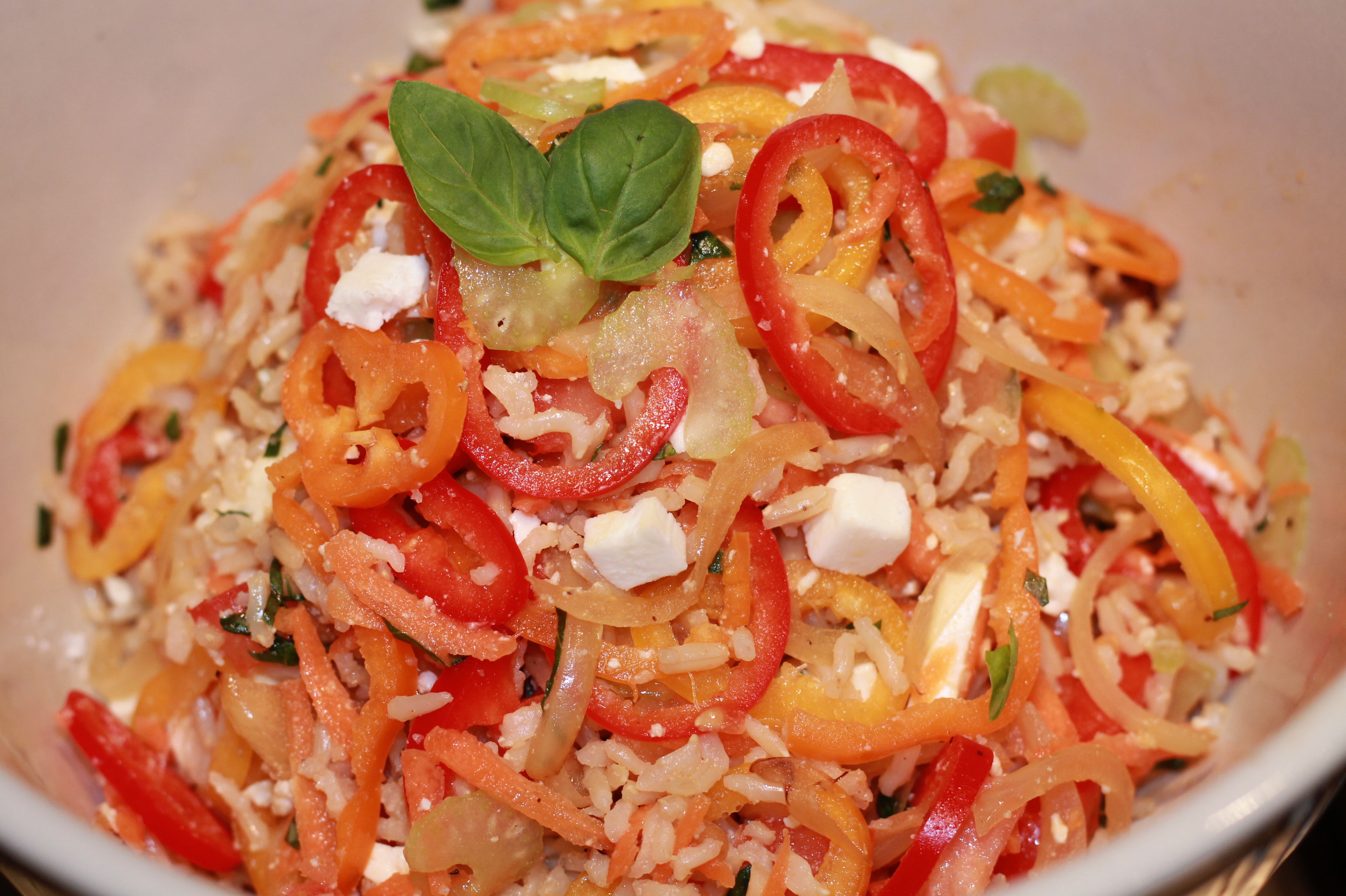
Quick Brown Rice and Feta Salad

Aside

Brown Rice and Feta Salad

Another quick post as I must admit I liked this one more than I thought I would. Isn’t this normally the way?

This started off a dinner this evening but ended up as tomorrow’s lunch. It’s a very simple salad of brown rice, feta and vegetables. It’s best served with the rice slightly warm.

  • 200g cooked brown rice
  • 1 large tomato, diced
  • 80g Feta cheese, diced
  • 1 onion finely sliced.
  • About two handfuls of mixed thinly sliced peppers (I used three whole mini versions)
  • 1 stick of celery very finely sliced
  • One carrot, grated
  • Juice of 1/2 lemon
  • 1 ‘glug’ of garlic infused oil (sorry workmates!)
  • 1 handful of chopped fresh basil leaves
  • Salt and pepper

What could be easier! Just prepare the vegetables and mix together in a bowl. I fried the onion to soften and sweeten it up first. Add the oil, lemon juice, salt and pepper (to taste) and mix well.

Curried Roast Parsnip Soup with Cumin Flavoured Croutons

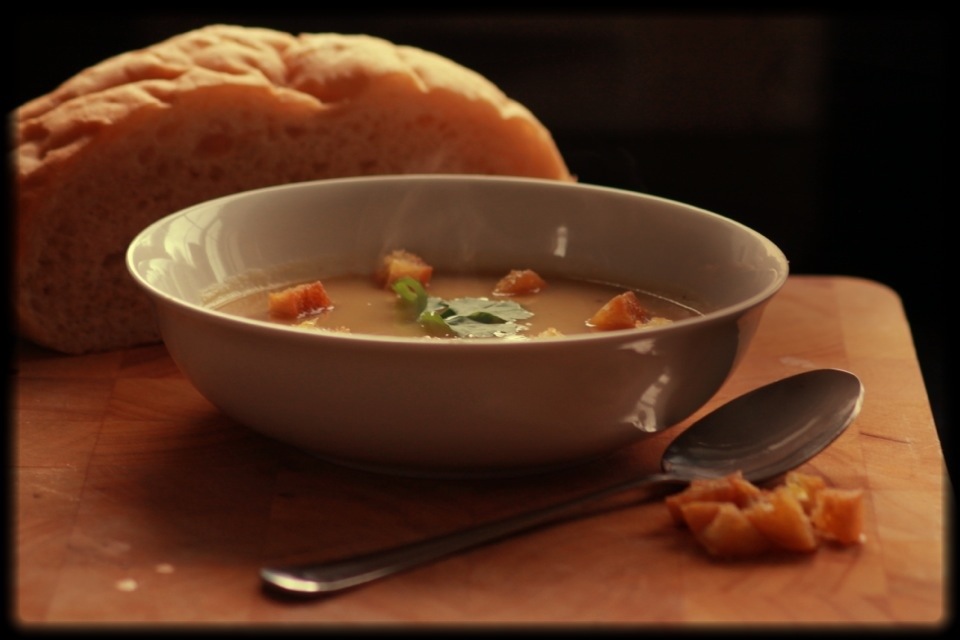
20130108-200323.jpg

A quick post tonight as my team is playing!

Pescatarian January is going well – in fact today was completely meat free, fish or otherwise. As a dedicated carnivore, it felt at first like the meals I made were ‘incomplete’, like it was missing the main attraction. I’ve since found that to be nonsense of course and although I will no doubt eat meat again, I’ll certainly not see it as the be all and end all of lunch and dinner.

I made this soup over the weekend and thought I’d drop it in (mainly because since my last post I’ve made a fish wrap that should never be seen in public and pasta, the subject of that post).

Parsnips work famously with curry spices and the croutons fried in garlic oil and cumin added welcome ‘bite’. As croutons generally are supposed to do, I guess!

Serves 2 with leftovers for work

2 tbsp oil (plus more to drizzle)
4 large parsnips
1 large onion, sliced
1 garlic clove, sliced
Vegetable stock (enough to cover)
1 heaped tbsp mild curry powder
Handful fresh coriander, finely chopped
2 Tbsp single cream (optional) to finish
Salt

A chunk of stale bread, cut into 1/2 inch or 1cm cubes
1/2 tsp cumin powder
Garlic oil

Peel and half the parsnips and place on a baking tray. Drizzle with oil, a little salt, and roast for about 40 minutes until nicely browned.

Once done, remove and allow to cool.

Meanwhile, in a large pan fry the garlic and onion until soft. Stir in the curry powder for a minute or so to release the flavour.

Chop the parsnips into large cubes and add to the pan.

Pour over enough stock to cover the vegetables and gently bring to a simmer for about 20 minutes (the parsnips are already cooked).

Take it off the heat and allow to cool for a while. Then, add the chopped coriander and blend either in the pan using a stick blender or in a separate blender (in batches if necessary).

Stir though the cream and leave to gently heat whilst you make the croutons:

Simply fry the bread cubes gently in the oil and cumin powder for a minute or two until golden brown and crunchy.

Serve in bowls with the croutons on top.

20130108-231920.jpg

Homemade Pasta

Homemade pasta

I can’t tell you the tantrums I’ve thrown making my own pasta over the years. I just could not get it to work. I used a pasta machine, but the strands always stuck back together in a clump, or when I did get them as far as the pan, it turned out blubbery and unappealing.

Then there is the mess of course. I’m not the tidiest cook I admit, but the kitchen looked a disaster zone and after getting such disappointing results, I wasn’t sure it was worth it. I’m also a fan of dry pasta, being much better for the types of dishes I prefer (tomato or oil based). I gave it another go though, being a little more experienced (read: older) these days.

In theory, it’s simple of course being a mixture of flour and water, or eggs. I went for a fresh egg pasta style based on Jamie Oliver’s recipe which basically comprises 600g ’00’ flour and 6 beaten eggs. I basically reduced the amounts down to 200g flour and 2 eggs for two servings. Very generous servings in fact.

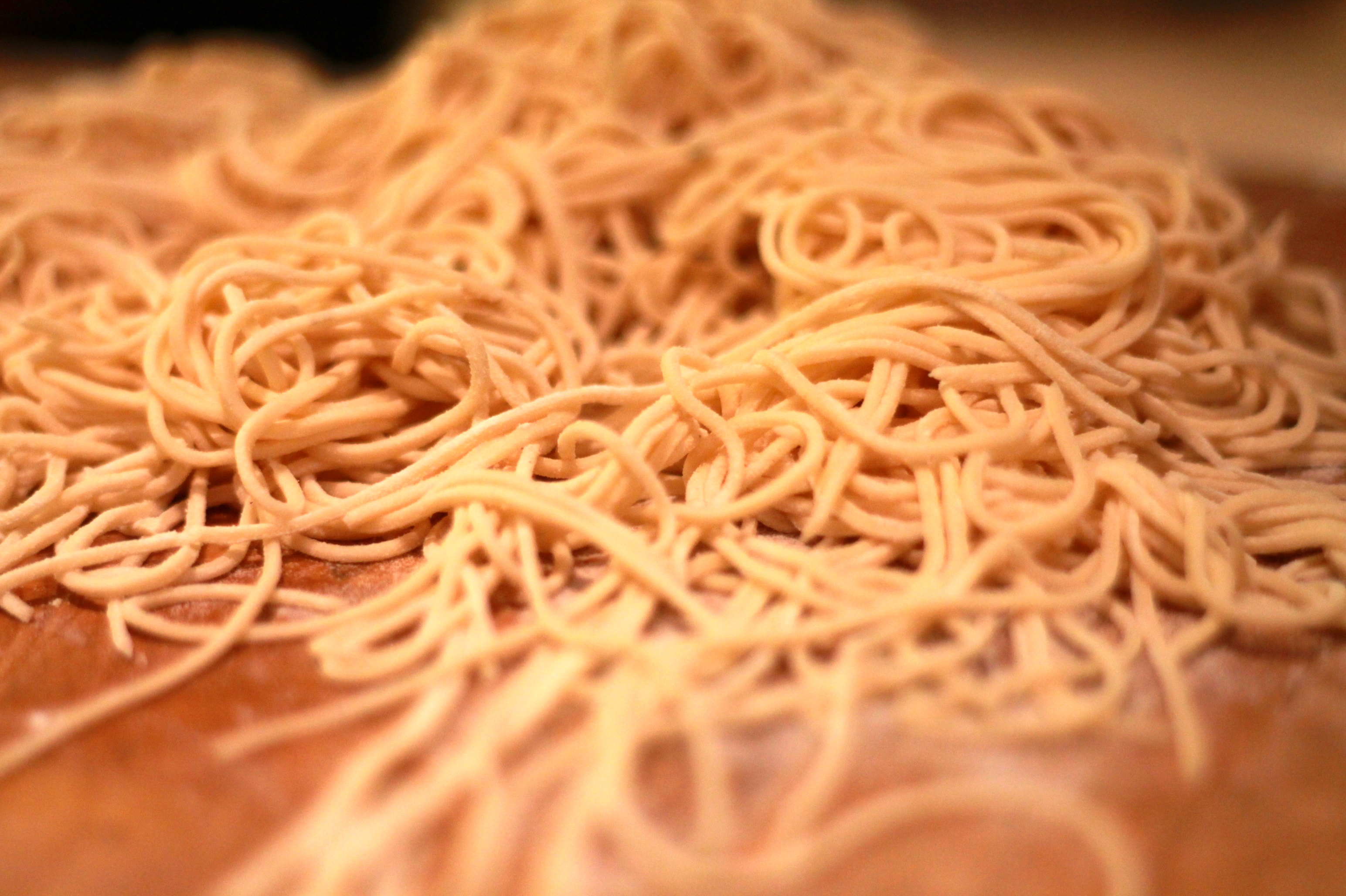
The difference I found this time though was in kneading it thoroughly – at least 5 minutes before leaving to rest in the fridge. The result was drier, much easier to cut and more importantly, much better to eat with a definite bite. It was a bit paler than convention dictates but then this is down to the colour of the eggs themselves. Next time, I’m going to try using just yolks to improve this though.

Veggie January has relaxed a bit to include fish, I just couldn’t do without. So I made a quick (low fat) creme fraiche based sauce with smoked salmon to go with it and it actually worked very well! I confess to using a small knob of butter though, essentially adding the fat that was removed from the creme fraiche, but it was a little bit ‘sharp’ and was better for it. Unlike my waistline….

Ingredients:

Pasta

  • 200g (just under a cup) ’00’ grade flour
  • 2 eggs beaten

Smoked salmon and creme fraiche sauce.

  • 2 tsp rapeseed oil
  • 1 tbsp whole capers, then chopped.
  • 150g smoked salmon
  • splash of white wine
  • 3 heaped tbsp creme fraiche (I used low fat but…..)
  • 1 small knob of butter – very much optional!
  • Salt (if needed) and black pepper.

;

Making the pasta

I used a small food processor for speed. Simplicity itself really, just blitz the eggs and flour together until you get ‘crumbs’. Then take it out and bind it together with your hands into a ball.

Then the hard bit – knead it! Five minutes minimum, but you do notice when it’s ready, becoming very smooth and pliable. Wrap it thoroughly in cling film and leave it in the fridge for 30 minutes at least.

Put a large pan of salted water on to boil now as it may take a while.

I used a pasta machine to roll it out, starting at the widest setting and finishing a number 2. To make it more manageable, I split the dough in two. Use a little flour to prevent the sheets sticking.

Rolling pasta

After the first roll, it’ll be a long oval shape, so just fold it up, like you would a tea towel and put it back through. It’s tricky but practise makes perfect I’m guessing.

Finally, I used the smaller cutter on the pasta machine to make spaghetti sized strands. Technically I believe its spaghetti alla chitarra (thank you Wiki), being square rather than round, but after cooking you can’t really tell.

Cutting pasta

At this point I recommend you make the sauce, as the pasta cooks in a couple of minutes:

Simply fry the smoked salmon and capers in the oil in a small sauce pan for a minute then add a splash of wine. Reduce it for a couple more minutes and stir in the creme fraiche. Heat through and season with black pepper and salt if it needs it – the smoked salmon was salty enough for me. Stir in the butter if you want to ;).

The water should be rapidly boiling so drop the pasta in, separating it with your fingers as you do. Stir well with a spaghetti spoon to ensure they stay separate. It’ll only take a couple of minutes to cook and slightly underdone is much better than well overdone so you need to keep attentive.

Once done, drain it and return to the pan. Stir in the sauce and mix well with the spaghetti spoon.

Sphaghetti with smoked salmon and creme fraiche

;

Sarah’s Homecured Bacon

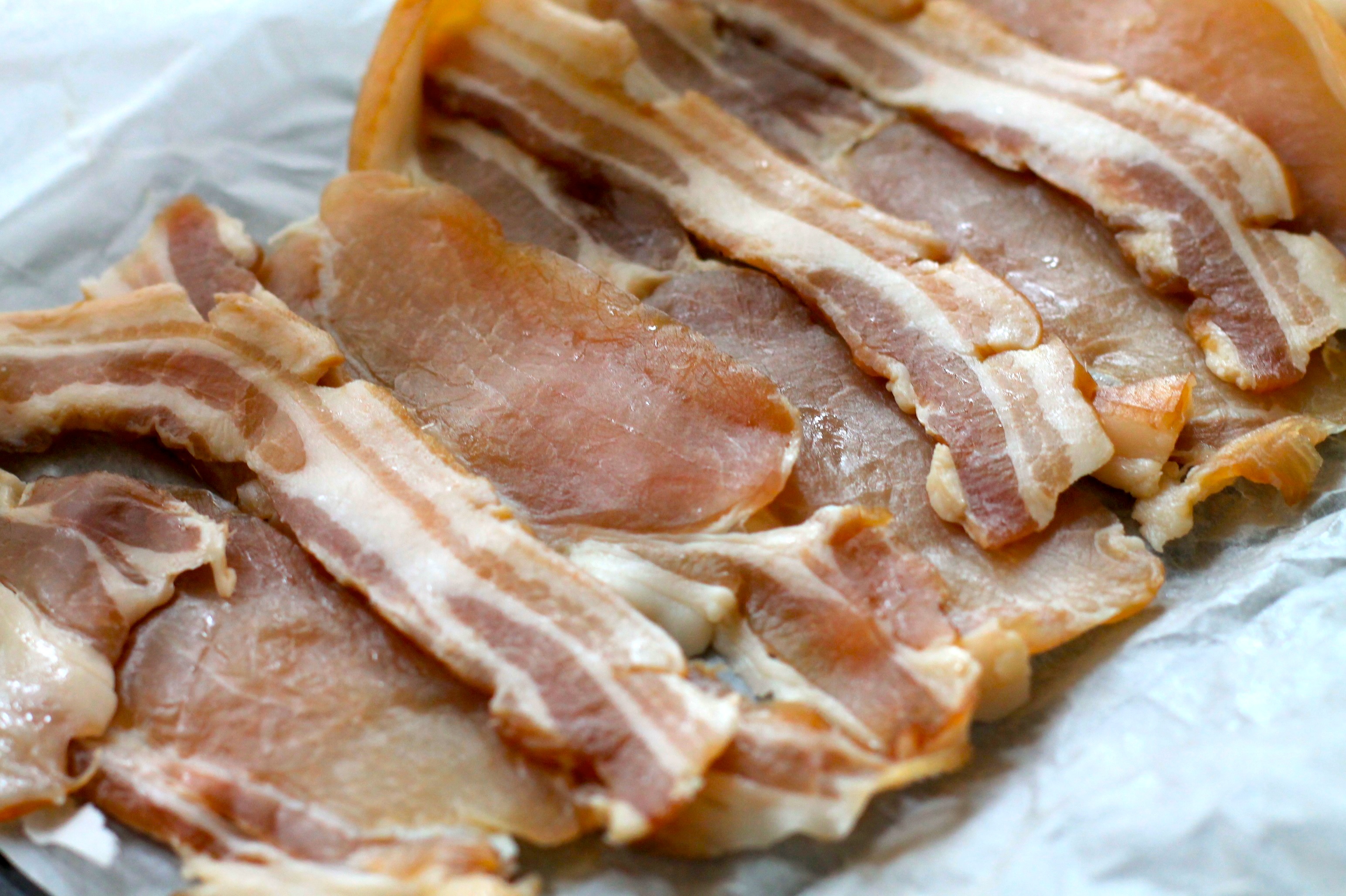
Our good friend Sarah visited us over Christmas and came armed with all sorts of great stuff to eat, including her latest batch of homemade bacon.

Now, in an attempt to reverse the effects of the sheer volume of pork products we got through over the festive break, we’ve decided to go vegetarian for January. More on that later of course.

So, as a last hurrah to 2012, I got Sarah to send over the basic recipe she followed which is itself based on a recipe by Hugh Fearnley-Whittingstall.

The skill is to cure the meat thoroughly, but without making it too salty, which I think she achieved nicely here. So, you’re left with the satisfaction of homemade bacon without the added water and added preservatives.

There are many versions out there but the basic method followed was:

Take a suitably sized piece of belly pork with the loin still attached. Score and pierce the rind and rub in plenty of salt, paying attention to the nooks and crannies. Leave it on a rack for 24 hours with a plate underneath in a cool place (but not the fridge).

Water will be drawn out of the meat into the plate so pour it away and reapply the salt.

Repeat for about 5 days.

After that, rinse the salt off thoroughly. Sarah said she soaked the meat for a couple of hours to help keep the saltiness down. Leave to dry.

It’s then ready to slice – she has a home slicer which makes it much easier! Of course there are other cures with ketchup, brown sugar, berries etc to experiment with.

Image

Game Pie

Game Pie

To those reading this, I hope you had and continue to have, a very pleasant Christmas! I most certainly did having spent most of Christmas Eve and Christmas Day, cooking, drinking and eating in roughly that order. The mixture of Ale, Red Wine and Single Malt Whisky is not a combination I would recommend in fairness, but then it is the ‘most wonderful time of the year’ and was hoping for a Boxing Day hangover reprieve. Unfortunately…..no.

I got the turkey from Northumberland Poultry this year and it was as delicious as it was massive (10Kg/22lb). It was however, for all intents and purposes, just a roast and therefore I thought I’d post something I’d made a couple of days earlier.

I had this Game Pie at a pub recently where it was part of a Christmas Menu, and loved it so I thought I’d try it out having never made one before for some strange reason. The wine is important here so use one you’re happy to drink. I used a Shiraz wine which is suited to game meat – some to cook with and some to enjoy with the results! The meat a pre-prepared diced mix from a supermarket, which wasn’t ideal, but never the less turned out nicely. It was a mixture of pheasant, mallard, partridge and, I think, pigeon. I added a couple of chicken thighs too as I needed to make it go a bit further.

I used a shop bought roll of puff pastry for the top though – I’m not a masochist ;). I do confess this may upset one of my friends who will insist this is not a pie, but a ‘stew with a hat’, but I hate to say I prefer this way sometimes as I’m not always in the mood to too much pastry. Also, and admittedly it’s a hollow gesture this time of year, it’s also slightly healthier of course!

We ate this on its own although a sweet potato mash would have been very good on the side we thought.

Serves 2-4 depending on how hungry you are, and takes 4 hours to 24 hours, depending on how long you have.

Ingredients:

  • About 500g of diced mixed game meat (I had 350g and made up the rest with chicken)
  • a handful of lardons or sliced bacon (about 4 slices)
  • 2 tbsp oil
  • a knob of butter (it was Christmas)
  • 1 medium carrot, sliced
  • 1 large celery stick, thinly sliced
  • 1 clove of garlic, finely sliced
  • 1 onion finely sliced
  • About 10 juniper berries
  • 300ml Shiraz wine (or any decent strong and ‘fruity’ red)
  • 200ml chicken stock
  • 1 boquet garni of thyme and rosemary
  • 2 tsp cornflour mixed with a little water
  • I ‘squirt’/tbsp of tomato puree
  • Salt and black pepper
  • 1 340g sheet of pre rolled puff pastry, or the same amount rolled 1/2 cm or 1/5 inch thick if in a block
  • 1 egg, beaten

Start by frying off the meat/bacon in the oil in a hot pan until well browned. Add the butter once nearly done (so as not to burn it) and reduce the heat a bit. Stir in the onions and garlic and soften for a few minutes at the lower heat with a good pinch of salt. Finally add the rest of the vegetables/berries followed by the wine, stock and tomato puree.

Add a generous twist of black pepper, but the bouquet garni on top, and gently simmer with the lid on for about 2 hours. The cooking liquid should be reduced, but stir in the the cornflour mixture at the end to thicken (if necessary). Taste and season if necessary.

Game Pie Mixture

Pour the mixture into a pie dish bearing in mind that the mixture needs to leave small gap at the top to accommodate the pastry. Allow to cool/rest preferably covered and left ovenight as it will be tastier the next day like any stew. I couldn’t wait that long though!

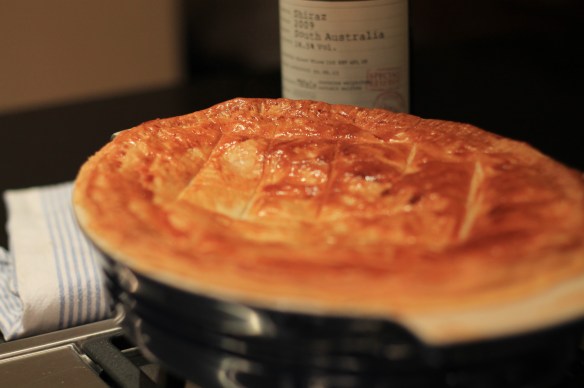
Once ready, preheat the oven to 190°c/370°f/Gas 5. Cover the dish with the puff pastry and use a knife to trim off the excess neatly. Use a fork to seal the pastry against the sides and a sharp knife to score (but not cut through) it in a criss-cross fashion.

IMG_5316

Paint the beaten egg on the top of the pastry with a pastry brush and place it in the oven for around 30-40 minutes until risen and browned all over.