Unknown's avatar

About Phil @foodfrankly

I love to eat and I love to cook. Always on the look out for new dishes and ingredients which isn't always compatible with a young family, but that won't stop me trying....

Pork, Spätzle and Sauerkraut

Pork, Spätzle and Sauerkraut

Once again the business has taken its toll on blog productivity but rest assured, I’ve not gone hungry. For some reason, of late, German food has been featuring fairly highly; first a (somewhat hazy) trip to Hamburg, then at various street food stalls and more recently my favourite local gastropub did an excellent Oktoberfest menu.

So, ever one to jump on the bandwagon and soak up inspiration shamelessly I decided to do something myself.

Being neither sweet-toothed, nor a particularly experienced baker I gave the Black Forest Gateau a wide birth, much to the dismay of Mrs Frankly.

It was only after a bit of Googling and Gastronomique thumbing, I came across Spätzle:  little irregular looking pieces of egg noodle, or mini dumplings, also associated with a number of countries neighbouring Germany. Whilst I’d heard of it, I’d never tried it and so that was that.

I suppose what I actually made was a kind of Käsespätzle as this did contain some cheese for a bit a lift. I must admit, there seem to be a few variations in size and shape – you can buy small grater/mandolin hybrid type devices to make small little pieces, but Wolfgang Puck recommended pushing the mixture through a large holed colander and that was good enough for me.

I actually used the larger disk that came with my a potato ricer. It seemed to do the trick nicely, but in hindsight I think the batter was maybe very slightly too wet (I adjusted the amount in the recipe below). Still, It was fun to do even if I didn’t exactly turn out to be to most photogenic of dishes. Tasty too.

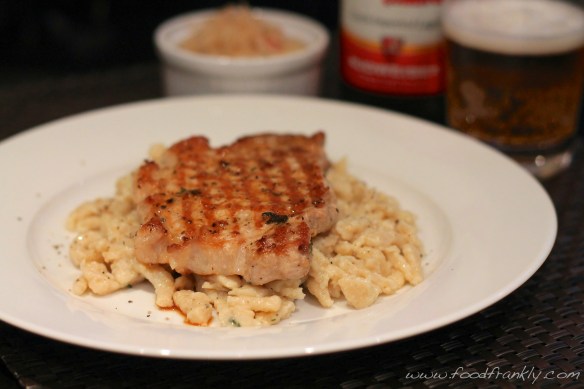
Admittedly, and a little predictably, I served it with some griddled pork chops and some warmed, ‘tweaked’ Sauerkraut, but it worked well. I simply marinaded the pork in garlic, salt and thyme first. Think I’ll try some Saurbraten next time or maybe a Goulash which seems to be a classic partner.

Perfect with a nice cold beer though it was a Budweiser Budvar, which is Czech, but it’s not too far away I suppose. Prost!

Serves 2 with leftovers…

For the Spätzle:

  • 125g/1 cup plain (all purpose flour)
  • 2 eggs
  • 2 tbsp butter melted, but about blood temperature
  • 3 tbsp milk
  • 2 large pinches of salt and pepper
  • 2 tbsp grated parmesan cheese

For the pork:

  • 2 good quality pork chops
  • Olive oil
  • Thyme
  • Salt and Pepper
  • Garlic

For the Sauerkraut:

  • 6 heaped tbsp Sauerkraut
  • A little mace
  • Small pinch of nutmeg
  • 75g bacon lardons, finely diced.
  • Salt and a little sugar to taste

For the Spätzle, mix the eggs, melted butter, cheese and milk in a jug and mix well. Tip the flour into a mixer, season and combine with the egg mixture using the paddle attachment for a minute on the lowest setting.

The resulting batter is pretty thick. Cover and leave in the fridge for an hour.

Whilst doing so, on a plate, mix a good ‘lug’ of olive oil with salt, a tbsp of fresh thyme leaves and a large clove of garlic (or two smaller ones), coarsely chopped. Flatten the chops slightly with a meat tenderiser and lay in the marinade for at least an hour, turning halfway through.

Garlic thyme and sea salt

Keep the pork out of the fridge so as to get to room temperature, which is better for cooking when you get to it.

In a small pan, fry the bacon lardons, there should be enough oil in them. Add the Sauerkraut, a dash of water, the spices and seasoning. Taste and adjust. Heat through and put a lid on the pan to keep warm.

Turn the oven on at 160°C/320°F

To make the Spätzle, get the kettle on to boil some water and add to a large pan. Salt, and bring to a rapid boil, as you would pasta.

Take the cold batter and load up the potato ricer!
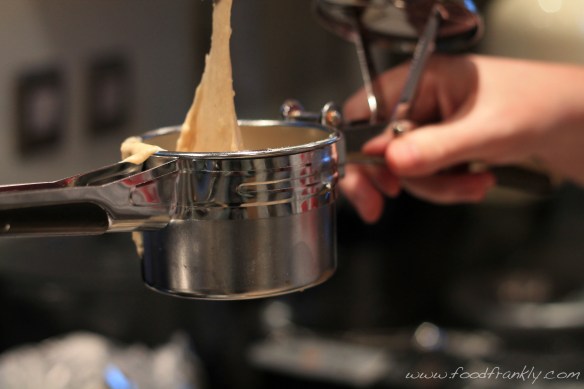
Spatzle with potato ricerOver the pan, squeeze a little of the mixture out and with the swift stroke of a a knife, cut them off so they fall into the water. Or the might drop of under their own weight.
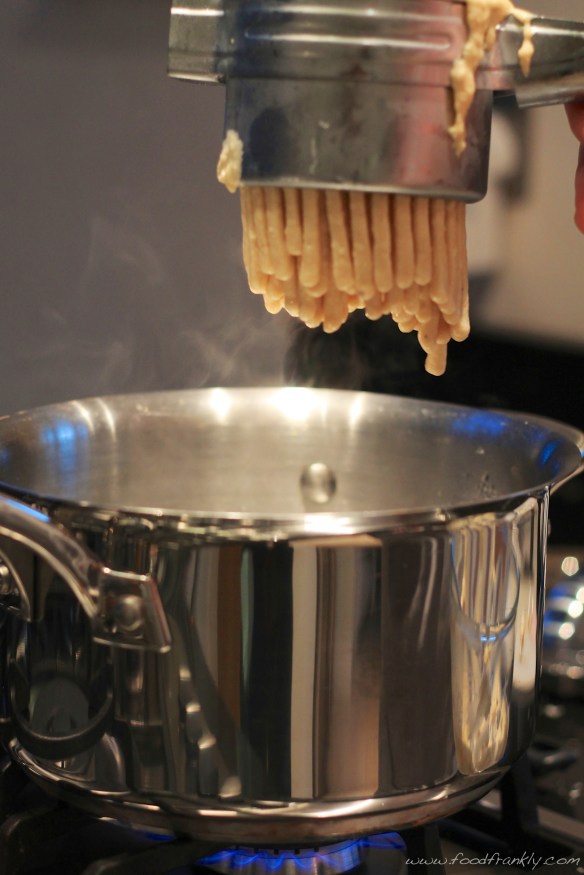
Anyone remember the Playdough Mop-Top Hair Shop?

Anyone remember the Pla-Do Mop Top Hair Shop? 

Do this for all the mixture and when they start to rise, much like gnocchi, it’s done. So, a couple of minutes should do it.

Immediately drain and plunge into cold water.

Scrape the large pieces of garlic from the pork, or they’ll burn, but keep them for later. Heat the griddle until smoking hot and griddle one side until you get nice bar marks in two directions.

Griddled pork chop

Turn over and transfer to the oven to finish off for a few minutes. Take care not to over do it, use a thermometer if you have one –  65°C/150°F, should see you right. Leave to rest in a warm place.
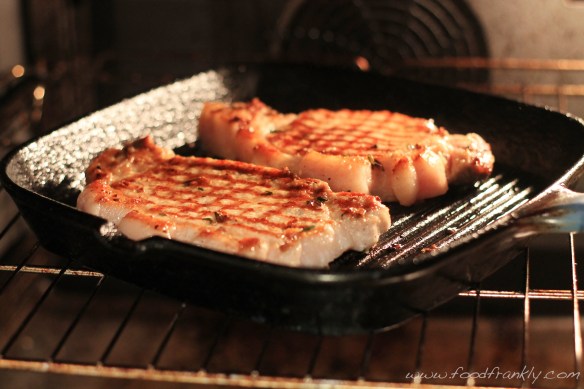
Pork chops

Dry the Spätzle using kitchen paper and fry in the remaining garlic/herb marinade with a little butter until coloured. Serve it all up.
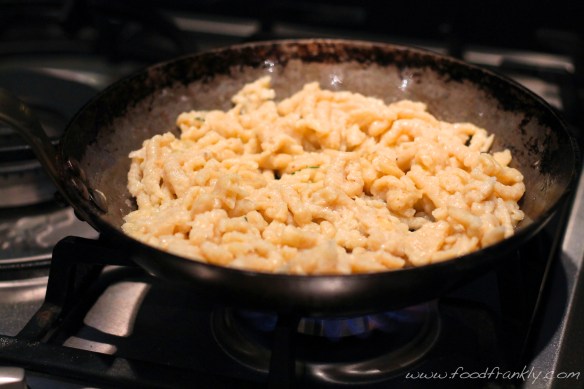
Sautéed Spätzle

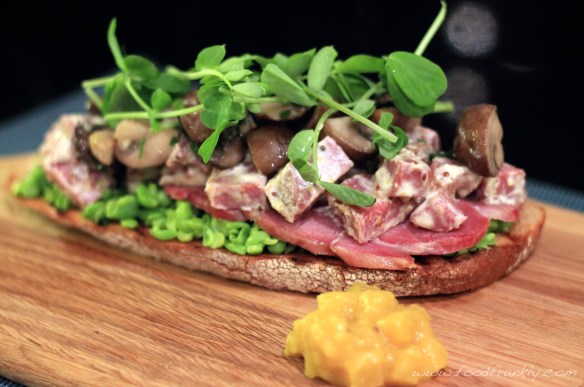
Gammon, Mushrooms and Peas on toast.

Gammon, mushrooms and peas on toast

Time sure flies hey? Plenty going on for us recently in and out of the Frankly household. We’ve been trying some great food and so culinary creativity, if ever there was any, has taken a bit of a back seat over the last few weeks.

This dish is unashamedly inspired (again) by a local gastropub and is another of those ‘on toast’ dishes. I offer no apologies for this, it’s probably one of the quickest and healthiest ways of introducing ‘crispy carbs’ and it’s delicious when griddled as I have here.

The gammon ham was actually from last Christmas and never got cooked, frozen and sat waiting patiently. In case I decided to take up curling or needed ammo for a trebuchet presumably. After defrosting I slow cooked this, initially in foil, for about four hours and it was meltingly good. Now, how to use up 2.5kg of smoked gammon….

So I came up with the following for a starters (but not a starter). I love this sort of thing – a bit rustic, quite simple and bags of flavour. Worth a try I’d say.

  • 2 slices of good quality bread
  • A little olive oil and a clove of garlic to rub
  • Cut 2 thin and two thick slices of gammon ham.
  • 2 tbsp crème fraiche
  • 1 heaped tsp coarse/wholegrain mustard
  • Black pepper
  • 150-200g chestnut (or similar) mushrooms, quartered or halved depending on size
  • 1 garlic clove, finely chopped
  • 1 little oil and a knob of butter
  • a handful of chopped parsley
  • Salt and pepper
  •  About 100g peas, frozen, unless you can get them really fresh
  •  Pea-shoots to finish

Prepare the ingredients first. Chop the thick gammon slices into dice sized pieces, slice the bread, quarter (or half) the mushrooms and finely chop the garlic and parsley.

In a small lidded pan, blanch the peas in a small lidded pan for a few minutes, turn off the heat and leave whilst you finish the rest.

Fry the gammon cubes in a little oil in a small skillet until coloured. Reduce the heat, stir in the creme fraiche and mustard and heat through. Season with pepper only. Transfer to a bowl, cover and keep warm in the oven. Put the two thin slices of gammon in there too to warm.

gammon & creme fraiche

Begin to heat a griddle pan on at this point, as it’s got to be hot.

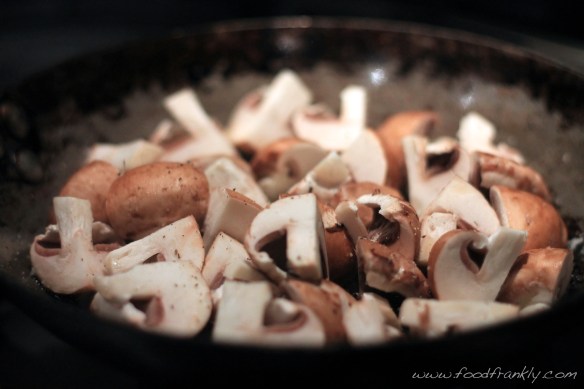
Wipe clean the skillet and heat the oil and butter for the mushrooms. Fry the mushrooms with the garlic for a few minutes until softened but not over-done. Season and stir in the parsley then set aside to keep warm.

Fried mushrooms

Drain the peas and crush them using a masher to break them up, season with a little salt and butter if you like. Cover the pan with the lid and set aside in the oven, again, to keep warm.

Rub the bread with the garlic clove and brush with oil on both sides. Sear each side on the griddle until nice charred bar marks appear.

Griddled bread

Layer the ingredients up as you prefer and top with the pea-shoots. Serve with some good piccalilli.

Gammon, mushrooms and peas on toast

Orecchiette with Prawns, Broad Beans and Chilli

orecchietteAhh, Italy – my gratitude extends to the whole nation. Great wines, great fashion (somewhat lost on me I admit), beautiful scenery, enthusiastic gesticulation and unobtainable supercars – the sort of things that makes one glad to be alive. Of course, if that wasn’t enough then there’s the food which, you may have realised, is where I was going with this intro.

Over the years the Italians have worked their magic to combine the most simple of ingredients into something far greater than the sum of their parts.

Here’s an example: wood fired oven margarita pizza. Bread, cheese and tomatoes, all cooked in a brick oven burning timber as we have for hundred of years. No sous vide, fan assist or thermostats and yet it is delicious and so, so much better for it for some reason. Witchcraft I tell you.

Here’s another, and the ultimate for me – pasta. On its own, it’s simple enough being just flour and water, or flour and egg, but with a few equally simple ingredients you have a dish for anyone. Even the most modest pasta dish has a kind of chic sophistication about it (again, a little lost on me), in fact the simpler the better.

Despite the ‘bean popping’ this sort of dish is one of my ‘late from the office’ go-to meals which is a shame, as it doesn’t deserve to be. It’s everything I love about Italian food. I know there are plenty of ‘rules’ or conventions in Italy on the choice of pasta shapes and accompaniments, but this worked just fine for me.

I’ve written a recipe, but honestly I wouldn’t expect many to follow it. In fact, most of the quantities in this one are approximate – this isn’t an exact science. Think of it more as a ‘serving suggestion’. Lovely with a good Pinot Grigio by the way.

Serves 2

  • 150-200g orecchiette pasta, depending how hungry you are
  • 2 tbsp cooking olive oil
  • About 1 tbsp good extra virgin olive oil to serve
  • 10-15 large raw prawns, deveined if necessary
  • 1 garlic glove, finely chopped
  • A small glass of wine (and a large one for yourself, it’s been a long day)
  • About 200g broad beans
  • 1 spring onion, finely sliced
  • A good pinch of chilli flakes
  • About a tablespoon measure of butter
  • Salt & Pepper.

Boil the kettle and get the water on.

Blanch the beans for a few minutes. I used the water for the pasta to save on pans, just don’t salt it yet. Sieve them out when done, salt the water and then and cook the pasta as instructed.

De-skin the beans by squeezing one end. Discard the skins. Keep the beans to one side.

Prawns and Chilli

In the pan, gently fry the garlic and prawns with a pinch of salt and the chilli flakes until well coloured. Add the wine and rapidly reduce to half the volume. Put in the beans, spring onion and the butter and warm through. Taste and season as needed.

Prawns chilli and broad beans

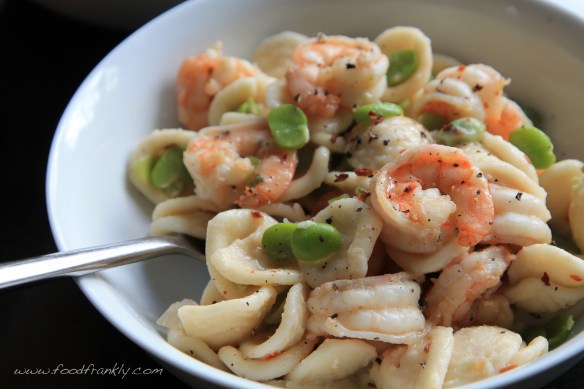
Drain the pasta when just ready and mix in the prawns and beans and a good lug of the olive oil. Serve with a twist of black pepper.

Orecchiette with prawns, chilli and broad beans

Planking, Tents and Food Festivals

Trending. Such a very 2010s phrase, used to describe by the vast tides of fickle popularity generated by ‘social’ media. But just think of Planking, the Harlem Shake and (soon enough) Twerking to see how fleeting this is. See, you’d forgotten them already.

Living in the UK, and having more than a fleeting interest I see food trends come and go in a similar, albeit less rapid fashion. The ‘modern’ Indian restaurant menu, cupcakes and food on a slate anyone?!

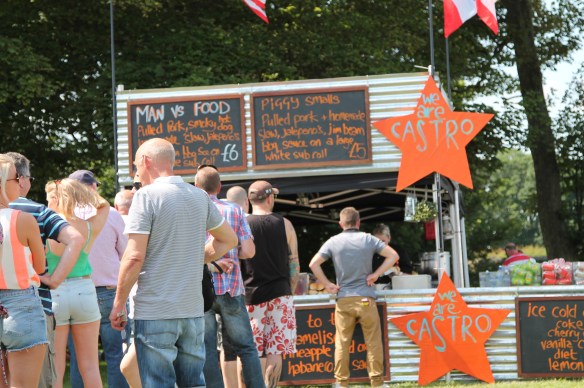
We’re currently awash with gourmet burgers, slow cooked meats and salted caramel and that’s no bad thing of course but one trend that does seem a little hit and miss, for me at least, is the rise of the food festival and specifically, ‘street food’. Done well, it’s delicious, exciting and genuinely interesting. The chance to sample street snacks from far flung cuisines had me reaching for my extra stretchy trousers, happily forking out a fiver for a cardboard plate of food and a napkin.

The Boiler Shope Steamer, Newcastle

The Boiler Shop Steamer, Newcastle – great fun, we’ll be back….

Street pizza at the Boiler Shop Steamer - very good.

Street pizza at the Boiler Shop Steamer – very good.

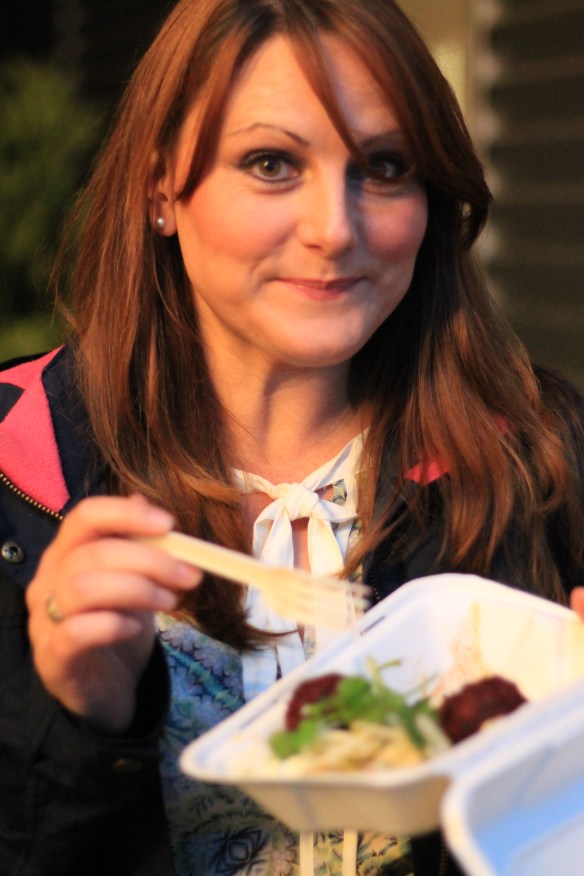
Helen enjoying beetroot falafel. I think I suprised her...

Helen enjoying beetroot falafel. I think I suprised her…

Done badly, however…..Well I’ve sampled a few such stalls over the summer and in some cases it seems pretty obvious that the purveyors are just ‘restaurants on tour’, or worse, those jumping on the bandwagon.

That’s not necessarily a bad thing of course when done well but I sometimes watched these poor souls, sweating in the summer heat trying to pull together something they could make with their eyes closed in their nicely fitted industrial kitchen. Now they’re in a tent, on a field, with a camping stove and a tiny table trying to cook and serve the customers simultaneously.

I think it’s fair to say the results are mixed. I recently paid £3 for a greek sausage sandwich. I’d never tried one before, and therefore I hope it was a bad example, but lets just say for once I was glad it was a stingy portion…

Conversely, some others are well setup for this form of cooking, particularly the BBQ guys with their beautiful smoking contraptions, Indian snacks and the good old Crepe stands of course. Food which originated in or suits the outdoors basically. I’m not sure a styrofoam tray of nuclear hot green Thai curry and rice does. And I love thai curries.

At the North East Chilli Festival

At the North East Chilli Festival

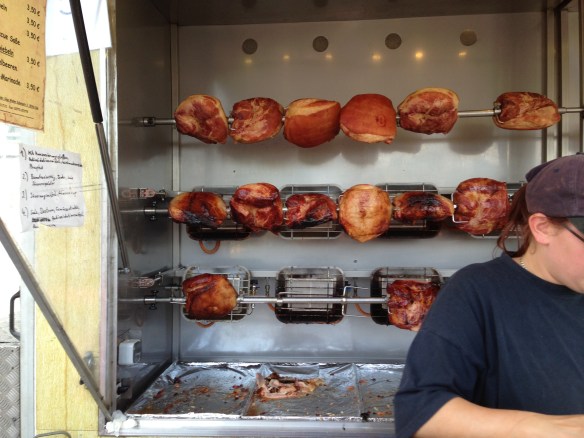
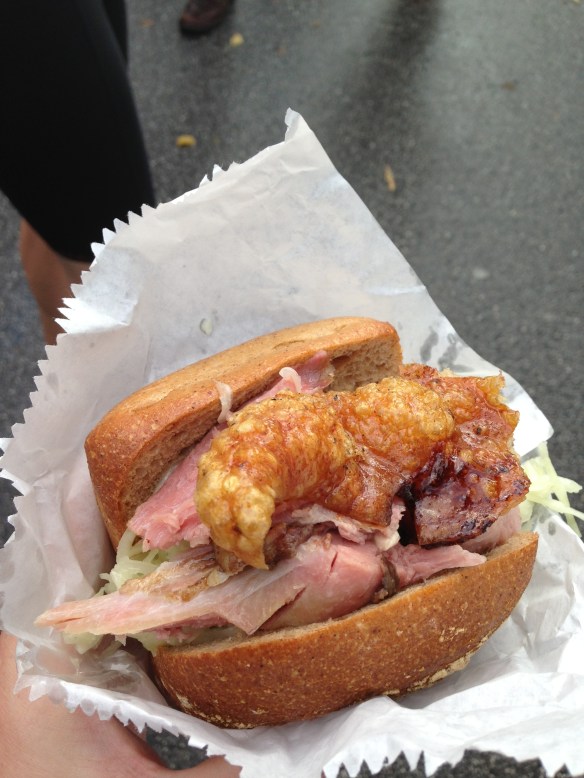
 Perhaps the biggest food festival I’ve been to this year however was in the Hamburg and wouldn’t you know it, the food was uniformly good and at times excellent. Typical. Rotisserie hams, slow cooked pork sandwiched, fresh donuts, excellent beer – although I think we run them very close here, bratwurst…I could go on. All run with that enviable German efficiency (even when it got busy, and boy, did it get busy) from custom made trailers or stands.

Rotisserie Hams, Hamburg

Rotisserie Hams, Hamburg

Roast Pork Sandwich, Hamburg

I’ve no doubt that the trend, originating in London’s wonderful cultural diversity, is slowly catching on, filtering its way up the country like electricity and mobile phones did in the last decade (no, not really). As such, I’m hopeful things will only continue to get better, but please, can we have more street food.

Venison meatballs and lentils

venison meatballs and lentils

Ah, it’s good to be back after a bit of a busy time. A little bit too much working hard and playing (not quite so) hard means a little less time for writing. Or cooking.

Holidays, festivals and rather messy Stag Do to Hamburg have all featured heavily over recent weeks and so I feel I’ve fallen behind a bit. Food markets seem to be a big feature of late though, they seem to be everywhere at the moment and I’ll be writing about this later.

For now though, I thought I’d share a dish I made last week before departing for Hamburg dressed like a complete tool.

This was another fridge-rummaging, wrinkly-bit-trimming special, to use up the leftovers before I left for the long weekend. I was fairly confident they wouldn’t be used in my absence 😉

This time, some frozen venison mince, a half opened pack of bacon, aubergine from a ratatouille that never was, carrots and a courgette/zuchinni were all involved in this super-hearty dish. Lentils, although one of my favourites were intended as a healthy gesture to ward away the bodily carnage that was to come. Absolutely futile.

green lentils

Serves 2-3

For the meatballs

  • 250g venison mince
  • 2 back bacon rashers, finely sliced
  • 2 shallots, minced
  • 1 tsp onion powder
  • 1-2 tsp smoked paprika
  • 1 tsp dried oregano
  • 2 tsp mustard (I used English)
  • 1 large handful breadcrumbs
  • Salt and pepper

For the sauce

  • 1 each: carrot, courgette, aubergine, sliced
  • 1 large red onion, coarsely chopped
  • 500ml beef or game stock
  • 2 tbsp tomato puree

Lentils

  • 150g lentils.
  • 750ml stock (chicken or vegetable)

Creme fraiche to serve.

Start by cooking the lentils in stock until tender – about 45 minutes. Simmer with the lid on until nearly done then take the lid off to concentrate the stock flavour.

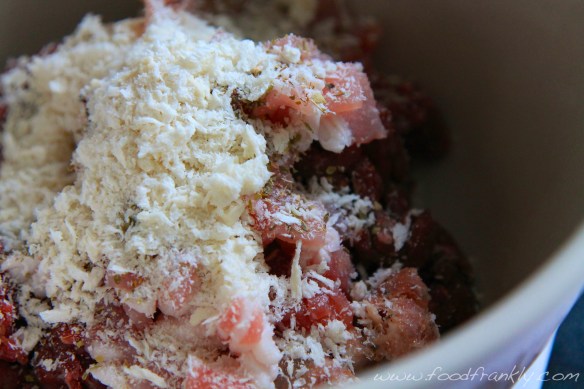
Make the meatballs by combining all the ingredients with your hand until evenly mixed.

venison meatball mixture

Season with about a tsp of salt and plenty of black pepper. Mix again to distribute.

Important bit: take a piece of the meat mixture off and fry it. Make any adjustments to the seasoning as you see fit.

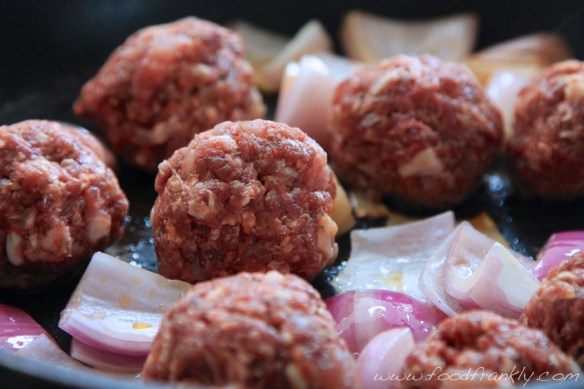
Roll the mixture into large meatballs – I got about 9 golf ball sized ones out of it.

frying venison meatballs

Fry the meatballs, onions and garlic in a decent amount of oil using a large lidded frying pan until well browned all over. Add the carrots and mix well. Pour in the stock and tomato puree and leave to simmer for a few minutes with the lid on to soften the carrot. Add the aubergine and courgette and simmer some more (5 minutes) with the lid on until they also softened.

venison meatballs

Finally, for a another five minutes, take the lid off and turn up the heat to concentrate the sauce.

Serve it all on the lentils with the creme fraiche. Filling.

venison meatballs and lentils

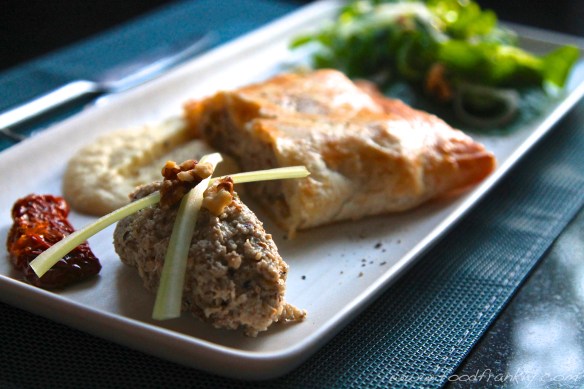
Sausage roll. Or, Pork and Apple Pastry, Walnut Pesto and Celeriac & Apple Puree.

Pork Pasty, Apple Celeriac Puree

Do you ever find that the best laid plans aren’t always the best? So many ‘good times’ in the past have been completely spontaneous.

There are exceptions, of course there are, but I often find the last minute trip away somewhere, unintended meeting of friends in a pub or off the cuff visit to that ‘restaurant we’ve been meaning to try’ are often more enjoyable.

It must have something to do with expectation of course. For any event, there will be an element of ‘rehearsal’ in your mind where you visualise how it’s going to go. God knows we did as teenagers eh fellas? And it was nothing like we imagined 😉

But, lifting the tone slightly, this can often happen when I cook. I sometimes come up with a great idea (or so it seemed in my mind at least), only to find it falls flat when the dish comes together.

Conversley, when the fridge is bare and you’re forced in a Ready Steady Cook  type improvisation situation (though no doubt minus the annoying presenters and studio audience)  you can come up with some corkers. As I said though, it’s probably about expectation isn’t it?

As you probably deduced by now, this dish was a last minute idea. I had celeriac slowly going soft in the fridge along with a half opened tray of pancetta and a piece of blue cheese rapidly approaching maximum ‘stinkiness’.  Add in the remains of the walnuts from my Khoresh Fesenjan last week and it started to come together itself really.

Although I really should call this ‘pork en croute’, or ‘minced pork parcels’, it was, for all intents and purposes, a sausage roll, albeit a posh one. Whatever though, I must admit, pastry work is not my forte, I really must practice to get some nice lattice work going on.

With it, pureed apple and celeriac and a pesto made from the blue cheese, walnuts a little honey and a little more apple.

You could use minced pork for this, it’ll be lower in fat, but I like making my own from belly slices as that fat keeps it from drying out.

Belly Pork and Pancetta

The puree is a little indulgent too, but you don’t need much.

Makes two large pastries (so 2 hungry people or 4 if you want to share!)

  • 1 large sheet ready rolled puff pastry.
  • 400g belly slices, minced.
  • 50g pancetta cubes
  • 1 tbsp wholegrain mustard
  • 1 tsp english (if you like it strong) or dijon (if not…)
  • 1 apple, peeled and cored
  • 1/2 tsp mace
  • 1 tsp chopped sage
  • 1/2 tsp dried oregano
  • Salt and pepper
  • 1 beaten egg for washing
  • Flour for dusting

For the puree

  • 1 celeriac, peeled and cubed
  • 4 shallots, sliced
  • 1 large garlic clove
  • 1 apple
  • 150ml cream
  • About a tbsp butter
  • Salt

For the pesto

  • Two handfuls of walnuts
  • About 40g blue cheese
  • Half an apple, peeled and diced.
  • 1 tbsp honey
  • Salt to taste

For the pastry, blend or mince the belly slices with the pancetta and peeled apple to make a fine mixture. Spoon into a bowl and add the mustards, herbs and pepper.

I used about a tsp of salt, but I strongly recommend frying a little bit in a pan to check the seasoning.

Roll out the puff pastry, and half it (the sheets are a standard size generally, but the size is up to you ultimately!)

Spoon on the pork mixture to the centre of one side of the pastry, not too thickly, so it cooks through.

Pork pasty filling

Brush the edges with egg to seal and fold the empty side over and seal with a fork. Place a small hole in the top to let the steam out.

Brush with egg wash and place in the oven at 200°C for about 20 minutes but ,as always, a thermometer helps to check the middle is cooked.

Meanwhile, chop the celeriac and boil for about 15 minutes until soft. Finely diced and fry  off 4 shallots and the garlic. Place the lot in a blender, with a peeled/cored apple and the cream. Blitz until smooth ( in batches if need be). Return to the pan and season to taste. Place on a very low heat to warm through then turn it off and put a lid on to keep warm.

To make the pesto, simply blend, or pound in a mortar the walnuts, honey, blue cheese and apple pieces until a coarse paste.

And thats it – serve it all up with a very good cider or a nice Riesling

Pork pastry and Apple Celeriac & Apple Puree

Persian evening and Khoresh Fesenjan

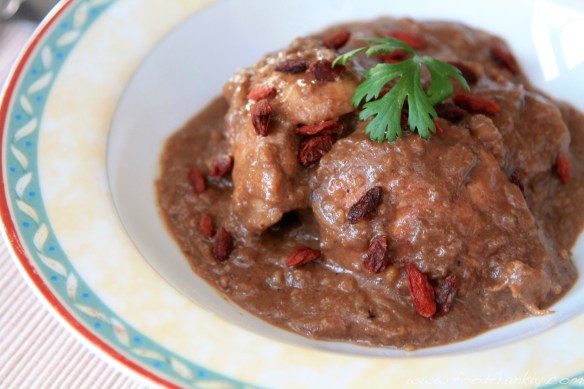
Khoresh Fasenjan

It’s good to be back after a nice trip away. Divonne, near the Swiss border and Geneva. It was lovely, thanks for asking. I’ll be doing something on this a France a bit later, but I’ve been meaning to write about this for a while now:

A little while back a friends of ours asked if we fancied a Persian supper club. Well, yes,  of course we did. I must admit to being fairly ignorant to food from this region and so jumped at the chance.

It was only when we were given the address that, I became a bit unsure. Thinking it was a special event at a restaurant I was suprised to find out it was actually at someones house. Now, being a ‘reserved’ kind of chap this made me a bit uneasy. Other than the guys I knew who else would be there? My God, what if I to chat to someone boring? Worse, what if I bored them?

Of course I’m an idiot. The whole evening was excellent and as it turned out, the only  couple we didn’t know there were lovely.

Persian supper club

The chef and supper club proprietor for the evening was Afsaneh, who I was delighted to find out made the latter stages of Masterchef last year. The menu was based on food from her native Iran and if you think you’ve had big portions I’d advise you to think again.

photo 2[1]

She actually has a website called Afsaneh’s Persian Kitchen with the details – I do recommend you try it if you’re in the area.

The food was excellent, varied and oh so plentiful. The assortment of Hors d’oeuvres, starters, breads, rice dishes and grains accompanying the meat dishes was amazing and God only knows how hard Afsaneh and team must have been worked to produce the banquet. And then there was the dessert, mint tea and petit fours. A hell of a feat.

So spurred on, I thought I’d try and recreate one of the evenings favourite dishes which, I think we all agreed, was Khoresh Fesenjan, a thick stew made from ground walnuts and tangy pomegranate molasses (to be honest though it was all good, I’ll be trying the others later…). I read around and found a few variations and borrowed bits from them. Otherwise though it isn’t a long ingredients list.

Pomegranate molasses is made from concentrated pomegranate juice, and is a wickedly tangy, sweet and sour condiment. The ground walnut make this a thick and deceptively filling meal on its own. You don’t need much.

I served this with some saffron rice. I think its more authentic to bake the rice until the bottom is a nice golden brown, so I’ll try this next time.

Serves 4. Easily.

  • 200g walnuts
  • 2 tbsp olive oil
  • 4 chicken thighs, I used boneless and skinless
  • 1 onion, finely sliced
  • 300ml chicken stock
  • 50ml pomegranate molasses (or to taste)
  • 2 bay leaves
  • 1 tbsp dried pomegranate seeds
  • 150g basmati rice
  • A pinch of saffron
  • A little brown sugar, again to taste
  • Salt and pepper

 Start by toasting the walnuts in a pan, being careful not to burn them. Allow to cool.

 In a casserole pot, fry the onions in the oil until softened. Add the chicken to brown (in batches) with salt and pepper. Once done, add 100ml of stock and the bay leaves and simmer with the lid on until just cooked through. Strain the stock and pour back with the rest and reserve the chicken and onion.

Blend the walnut until a coarse powder. Reserve a few and coarsely chop them for a bit of texture, which I liked. Pour 200ml of the stock into the pot and bring to a simmer. Stir in the walnuts to make a thick paste. The oil will begin to rise to the top – keep stirring it. Add the pomegranate molasses. I suggest you add little by little to taste as it is quite powerful and sharp. 50ml was about right for me in this case.

Pomegranate molasses

 Add the sugar to balance the flavours and then return the chicken and onions. Simmer with the lid on for an hours, adding a little of the remaining stock to loosen if too thick. Season with salt.

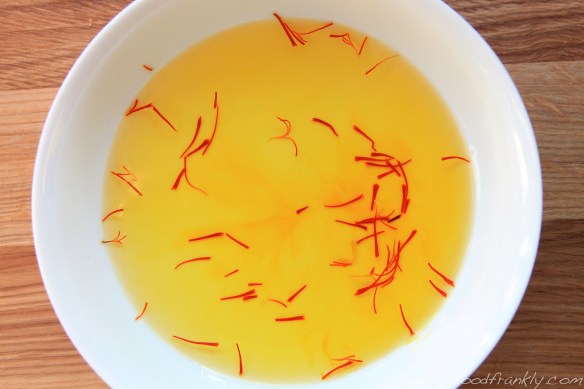
Saffron Water

Cook the rice as you normally would. I use the absorbtion method, using twice the amount of water to rice in a shallow pan. Add some hot water to a bowl and blanch the saffron to colour and flavour it. Add this to the rice towards the end of cooking.

Khoresh Fesenjan and Saffron Rice

Curried Lamb Shanks and Naan Bread.

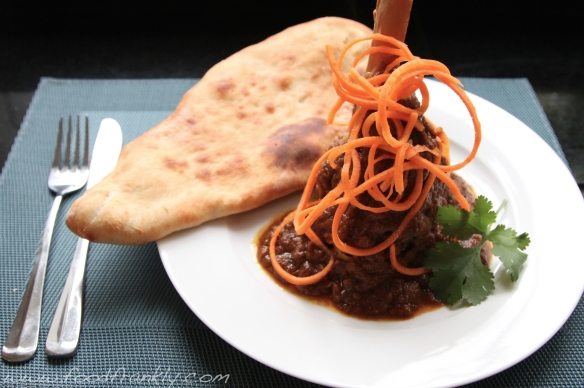
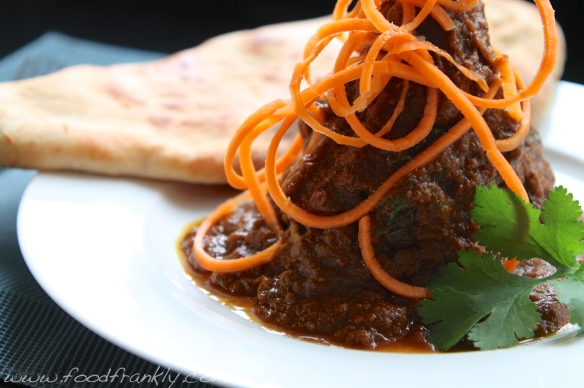
Curried Lamb Shanks

OK, so even I’m getting over BBQ food at the moment. And salads, lovely as they are in the garden with a glass of something cold are getting a bit tiresome.

It’s a bit weird that I don’t see curry as a summer food as the Indians eat this in far warmer climes than these, but maybe it’s just me. So, fight fire with fire I say and with my added side-quest to get my wife to enjoy a lamb dish this a pretty risky proposition.

I'm slaving away. The muggy gets my chair. Hmm...

I’m slaving away. The moggy gets my chair. Hmm…

I’ve managed to establish that Helen’s dislike of lamb is down to the ‘lambiness’ of some dishes. Now this is a major breakthrough. We recently went to a brilliant Persian supper club meal with friends (more on this in a later post) and she thoroughly enjoyed the slow cooked lamb. I think I’ve deduced therefore that whilst the Sunday roast will never be an option, maybe this type of dish will, having had most of the fat rendered out.

So, I bought a couple of lamb shanks, classic slow cooking cuts, from a local butcher. Otherwise, I didn’t need to look far for inspiration as I’ve been meaning to make a dish I found on an app I have for  Hyderabadi Shanks by Alfred Prasad on the Great British Chefs website. A great website by the way and well worth a browse.

I made a few minor tweaks for our own tastes/available ingredients but otherwise tried to stay faithful to the recipe. I slow cooked the shanks for about 3 hours and then left them to  rest overnight before finishing the curry the next evening.

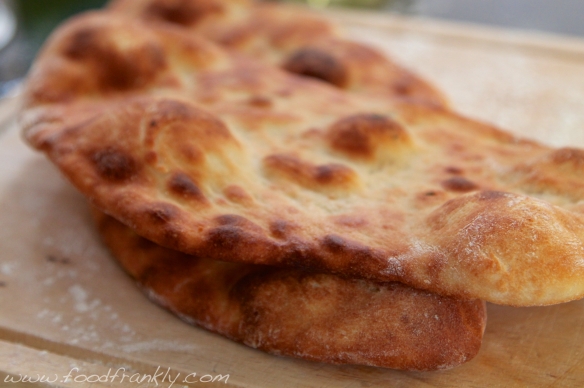
To accompany this, some homemade naan breads. Simple in theory, these are fairly difficult to do in domestic ovens, as the lovely light airy versions you find in restaurants are made using a super-hot tandoori oven. I improvised using a pizza stone in the oven at full whack – a respectable 275°C (530°F). The results were pretty good to be fair.

Naan Breads

The recipes make about 5 (or more depending on size) but freeze well for later on.

Serves 2:

For the curry:

  • Two lamb shanks
  • 4 tbsp oil
  • 1 1/2 onions, thinly sliced
  • 6 garlic cloves and a large piece of ginger
  • 6 cloves
  • 4 cardamon pods
  • 1 1/2 tsp cinnamon powder
  • 1 tbsp mustard seeds
  • 1 tsp hot chilli powder
  • 2 tsp ground cumin
  • 2 tbsp ground coriander
  • 4 tbsp yoghurt
  • 3 ripe tomatoes, diced
  • Chicken stock – about 500ml (enough to cover the lamb) or water if not.
  • 1 tbsp garam masala and a good handful of chopped coriander stems/leaf to finish.
  • 1 threaded carrot to serve.

For the naan breads (makes 4-5 large)

  • 500g strong bread flour
  • 2 tbsp oil
  • 1 tsp salt
  • 1 sachet of dried instant yeast
  • 200ml milk
  • 100ml yoghurt (about 4 tbsp)
  • Melted butter to finish, if you like.

I used dried coriander and cumin and so dry roasted them first in the hot pan and ground them in a spice mill. Set aside.

Make a paste out of the garlic and ginger by blending them with a little water (or a good old fashioned pestle and mortar)

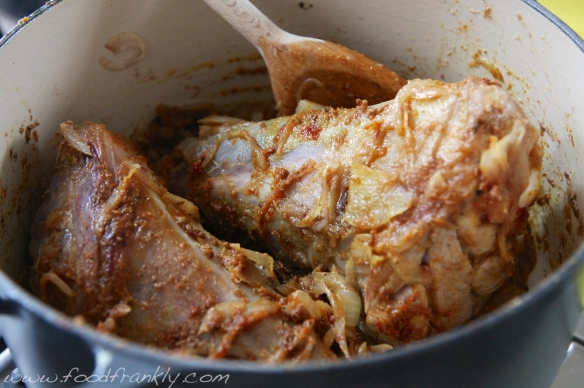
Add the oil to a large oven proof pan and fry the cardamon, mustard seed, onion, and cloves for a couple of minutes. Push to one side and add the lamb shanks to brown well, with a good pinch of salt.

Add the ginger/garlic paste and stir to coat. Then the  rest of the spices – the chilli powder, coriander, cumin and cinnamon. Continue to fry for a couple of minutes – it smells amazing.

Lamb shanks with spices

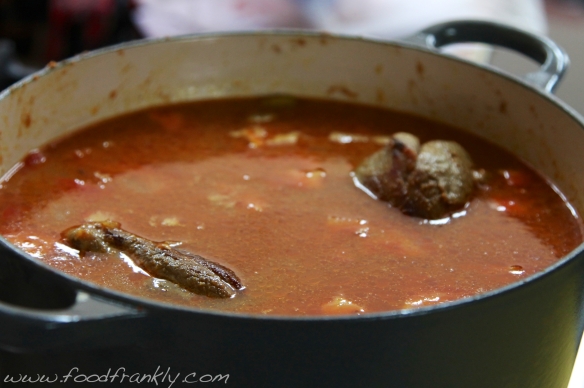
Add the yoghurt and tomatoes and simmer in the oil for a few minutes more then cover the lamb with the chicken stock.

Curried Lamb Shanks

Simmer on the hob on the lowest heat setting, or in the oven at 140°C/280°F for 3 hours. Rest over night if you can, but it’s not necessary.

When ready to cook, remove the lamb from the sauce and set aside in a roasting pan. I covered it with foil and used my smaller oven to warm (only 100°C/210°F)

Pour off any unwanted oil (there was quite a lot) and blend the sauce until smooth. I used a stick blender for less washing up 😉

Simmer gently until thickened. Once done, turn off the heat and once stopped simmering stir in the garam masala and coriander stems/leaves.

Meanwhile, make the naan dough by combining everything and kneading until smooth and stretchy. I used the dough hook on my mixer – a Godsend – but keep an eye on it or it can be over kneaded. I used the stretch test after 5 minutes and it was done.

Leave to rise once until double the size somewhere warm and get the oven ready. I got the pizza stone in the middle of the oven and set it to max. Flatten and portion the dough and roll out to a tear-drop shape, brush with oil and when the oven is ready, place it straight onto the stone. It bubbles up really quickly and can burn so watch it carefully! Brush with the butter once done if you are using it. Cook them all whilst the oven is on and freeze the excess for another day.

Naan Breads

Plate up the lamb shanks and pour over the sauce generously. Finish with the carrot, a naan bread and a Cobra beer.

Curried Lamb Shank

Char-grilled Seabass and Panzanella Salad

IMG_0077-impIf you’re reading this I’d imagine you have a bit of an interest in cooking and good food, which can be both a blessing and a curse when going out to eat.

See, like most of you, it becomes quickly apparent when a dish arrives, how much effort went into the preparation and the ingredients involved. Once you’ve established this, it quickly  becomes even more apparent whether the price you’re paying is ‘fair’.

Last night we went out for dinner at a decent chain Italian restaurant in the City, mainly, seeing as the weather is so good, for the outdoor seating. I tend to avoid chains, as invariably I leave, at best, underwhelmed, or at worst slightly annoyed. Whilst most are very nicely decked out with exposed timbers, shabby-chic fixtures and theme driven posters, a majority of them with their advantageous locations have high ground rents and wage bills and, therefore, squeezed margins. So what gives? Inevitably it’s the food, be it in the quantity or, and more importantly, the quality.

Lat night I ordered the Cacciucco – a kind of Tuscan fish stew with Sardinian fregola. Perfect summer food I thought. But then when it arrived the squid (both pieces) were more akin to a fan belt. It also comprised a handful of fregola, two small slivers of fish, three very small clams, two mussels and a prawn. Yes, a single prawn. Two large pieces of bread were added, presumably to resemble anything like a meal and take up half the plate – completing the illusion.  All for a “bargain” £16.95.

If there were £2 worth of ingredients in the dish I’d be surprised, especially at wholesale prices. I was hardly expecting Bouillabaisse from the Southern coast of France but still…

Ah, well, weather was good and the Peroni was cold.

Across town there’s a great  family run restaurant called Panis. I’ve mentioned it before. It won’t win a Michelin star but it’s proper Sardinian food with half the decor and half the price.  The service is also great and no loyalty cards are being pushed. Sadly, no al-fresco dining, but lesson learned.

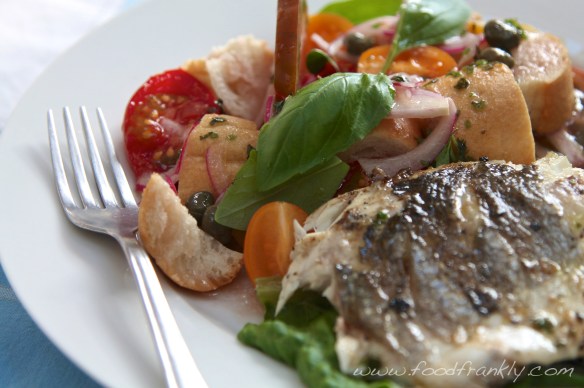
So being the bloody-minded type, I had to force the point home by making one of the most modest of salads – panzanella – and with it, some seabass fillets. The cost? £7 for both of us. £6 of it being the fish.

IMG_0057-imp

The key ingredient of panzanella of course it some stale bread, it’s a brilliant way to use up an old loaf if you’ve too many breadcrumbs already, or even if you don’t.

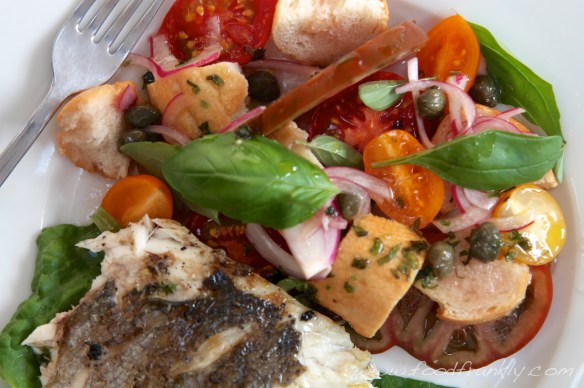
I used a mixture of tomatoes (oven drying some of them) for a bit of variety, some green leaves, and herbs from the garden. The dressing itself was also so simple, even forgoing the balsamic for the more austere red-wine vinegar.

IMG_0062-imp

Marjoram doing nicely in the garden

Not sure what variety this is, should have taken note. Anyone?

Not sure what variety this is, I should have taken note. Anyone?

IMG_0053-imp

I cooked the seabass on the grill outside with woodchips for smoke and whilst delicious, mine did break. A schoolboy error for the presentation. Unfortunately the other one was being tucked into by Helen….

Serves 2:

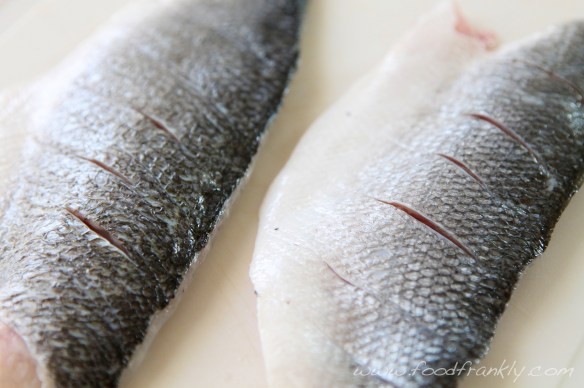
  • 2 seabass fillets
  • 1 tbsp olive oil
  • Salt

For the salad:

  • Half a red onion, finely sliced
  • A mixture of tomatoes, halved or quartered
  • Stale bread, cut into cubes. As much as you need.
  • 2 tbsp capers
  • 1 sprig of marjoram or fresh oregano, leaves removed
  • A few basil leaves

For the dressing:

  • 2 tbsp good olive oil
  • 2 tbsp red wine vinegar
  • 1/2 to 1 tsp sugar (to taste)
  • Salt to taste

Make the dressing up then separate and add the finely sliced onions to mellow a bit while you do the rest.

I made oven dried tomatoes by halving 4 of them, sprinkling with a little salt and baking on a tray for about 15 minutes at 160°C/320°F. Remove and leave to cool.

Arrange the plate with the salad ingredients.

Season and grill the fish until just done – sea bass doesn’t take long if at room temperature, just few minutes.

Arrange it on the plate with the rest and dress the salad with the, making sure the bread gets plenty of the vinaigrette.

Enjoy with a sense of smug satisfaction!

Seabass and Panzanella Salad


BBQ Leftovers Salad

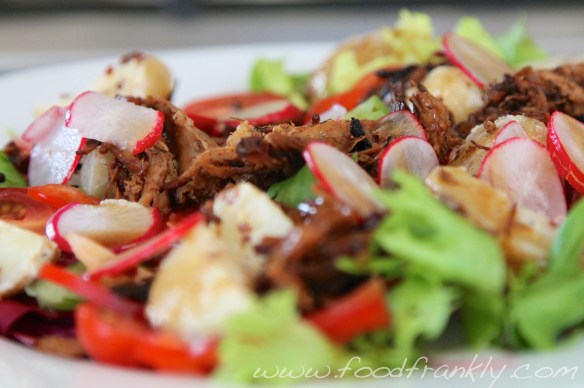
Pulled pork salad

Well summer is here, Murray just won his first Wimbledon, the Lions won down-under and ‘al fresco’ food is irresistible during these long days.

I often think this would be a different nation with decent weather as at the first glimpse of sun and everyone is out and about. In town, any available outside seating, and there isn’t much, is taken and plumes of BBQ smoke are rising from the gardens. Great times…..except for the bad tan-lines but otherwise, yes, great times.

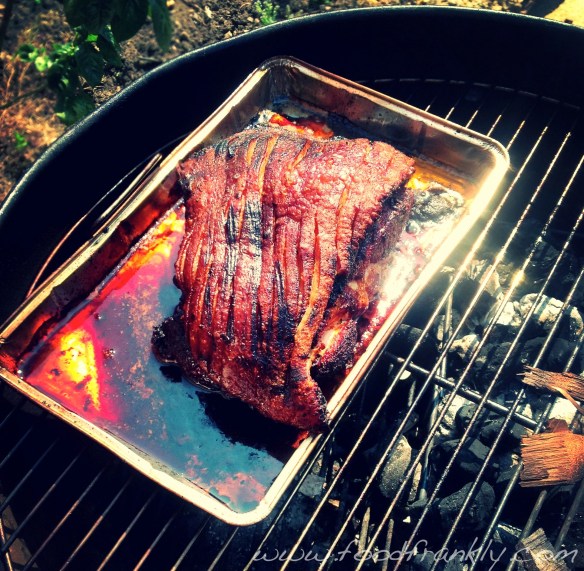
I ‘did’ a BBQ on Sunday and, as ever, prepared far too much. I got the Webber kettle grill out and slow roasted a piece of pork until falling apart, soaked wood-chips and all. It made the most amazing crackling too. Suffice to say it was such a shame to waste it and so in a vain attempt to do something healthier, I combined some of the leftovers into a salad.

BBQ Pork

(a stylised Twitter pic!)

No recipe as such here, but this was super-quick and hugely customisable. I used an asian style dressing but a simple cider-vinegar version would have worked nicely too. I also had some of Helen’s homemade coleslaw left which finished the dinner off nicely.

BBQ pork salad